AI Can Generate Strategies at Scale. Which Ones Should You Kill?
AI made trading ideas cheap—and lucky backtests plentiful. The scarce part is a research loop that can reproduce, stress, compare, and reject weak strategies before they reach real money.
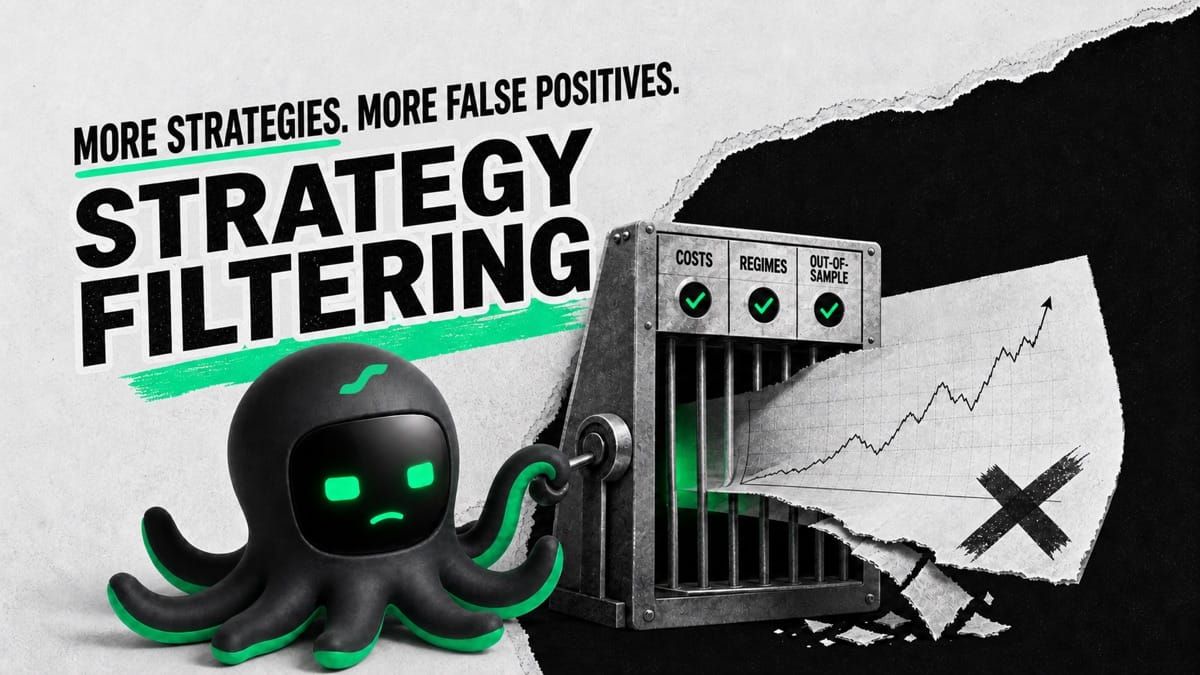
AI can hand you 100 trading strategies before lunch. The expensive step is number 101: figuring out which of those backtests merely got lucky with history. Faster generation creates more beautiful curves—and more ways to put real money behind a false positive. This article is not another prompt for generating strategies. It is a practical filter for deciding what to reproduce, stress, revise, or kill before a strategy reaches an account.
That is the mistake at the center of many AI quant products. They treat “writes more strategies” as the feature, as if another pull of the lever must bring alpha closer. It is closer to installing a faster printer in a room full of lottery tickets.
Cheap generation creates false positives at wholesale
One algorithmic-trading community member described building roughly 50 AI-assisted strategies, moving 10 into simulation, and seeing four look promising so far. That anecdote proves nothing by itself. The useful part was the pushback: How were the four selected? Were they correlated? Was the simulation long enough? Were there hidden implementation errors? The thread exposes the real bottleneck. Idea generation is approaching zero cost; trustworthy rejection is not.
The statistics are not mysterious. Test enough ideas and some will look exceptional by chance. Bailey and co-authors explain in their work on the probability of backtest overfitting why the in-sample winner among many trials can disappoint out of sample. Harvey and Liu similarly show how multiple testing can make lucky discoveries look like genuine trading effects.
AI did not invent this problem. It pressed the accelerator, turning a failure mode once constrained by manual research speed into a high-frequency problem.
The missing product is a strategy record—not more code
A typical quant workflow is scattered. The thesis lives in a chat. Parameters live in a script. The data window lives in a backtester. Fees live in a settings panel. Conclusions live in a spreadsheet. On the next run, one piece changes and the strategy still has the same name, even though the experiment no longer has the same conditions.
That is a dangerous class of error because nothing has to crash. The equity curve still renders. Sharpe still has two decimal places. You simply stop knowing what you are comparing.
| Research action | Fragmented workflow | Better product shape |
|---|---|---|
| Capture the thesis | Chat and code drift apart | Intent and executable rules share one strategy version |
| Change assumptions | Fees, slippage, time zones drift silently | Data windows, costs, and parameters remain inspectable inputs |
| Interrogate results | Open another tool and restate context | Stress the same evidence across costs, regimes, and out-of-sample data |
| Make a decision | Keep the prettiest screenshot | Record keep, revise, or stop—and why |
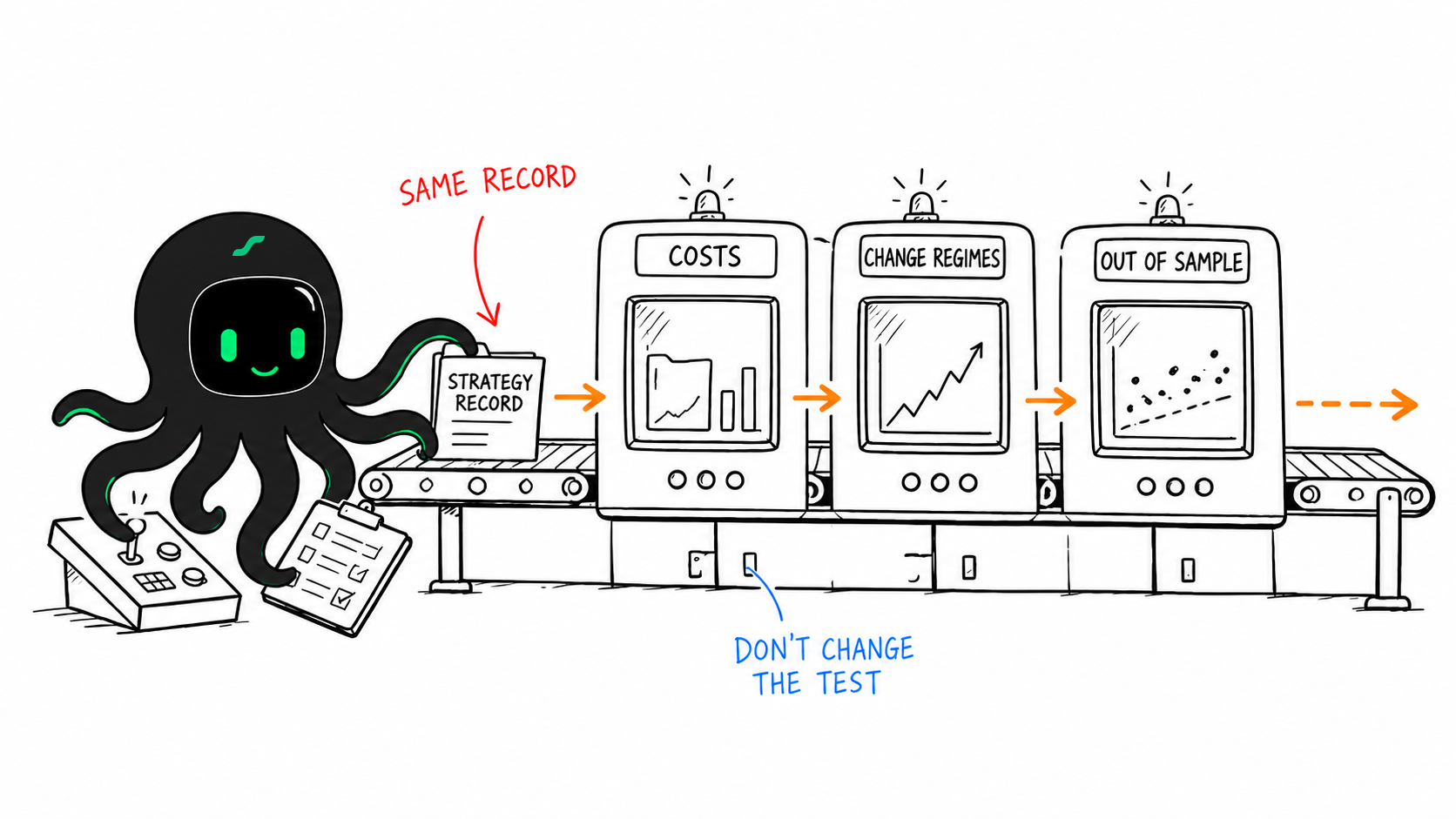
That is why a useful AI quant product should not be organized around how many strategies it produces. It should keep one strategy’s rules, assumptions, costs, evidence, and test history together, so every follow-up continues from the last result instead of drawing another ticket.
Why one button cannot turn a backtest into an answer
The answer is not “chat is friendly.” A chat box does not create rigor. A language model can misunderstand a rule, write faulty code, or tell a persuasive story about a seductive curve. The useful property is turning a natural-language follow-up into the next executable test on the same strategy.
Suppose you say, “This moving-average strategy looks good.” A generator is optimized to offer five parameter variations. A better research process should ask less exciting, more valuable questions:
- What survives after fees and slippage double?
- Does the conclusion change when 90 days becomes 365?
- How does it behave in trends, chop, and extreme volatility?
- Are nearby parameters also profitable, or is the optimum a needle?
- Does it survive out-of-sample data, delay, and worse fills?
None of that sounds like AI magic. Those questions are the difference between research and a screenshot that talks.
Why EdgePilot takes this product shape
EdgePilot’s evidence and methodology keeps provenance, data windows, assumptions, costs, and out-of-sample results attached to strategy evaluation. It reviews configuration structure, parameter bounds, executable formulas, historical backtests, and robustness. The product is not trying to help users think of more things. It is trying to make it harder for the same idea to quietly change its test conditions.
The EdgePilot Research loop is therefore:
- State the idea. Describe the rule and the problem in natural language.
- Make it inspectable. Expose the data window, parameters, costs, metrics, and executable conditions.
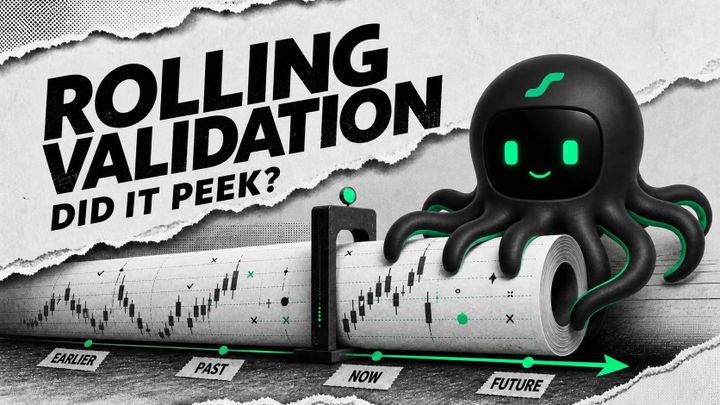
- Try to break it. Raise costs, add delay, change regimes, and compare in-sample with out-of-sample behavior.
- Make a disposition. Continue testing, revise the thesis, or stop—with reasons.
The benefit is deliberately unglamorous. AI proves its value by shortening the time to a credible decision, not by maximizing output. Strategy 101 may take ten seconds to generate. Discovering why strategy three is not worth another week can save far more.
The strongest objection: putting everything together can still produce the wrong answer
That objection is correct. Putting everything on one screen does not make the data right. A continuous conversation is not the same as a reproducible experiment. Survivorship bias, look-ahead leakage, understated costs, and confirmation-seeking users can still produce a polished result that should not be trusted.
This product shape works only when four conditions hold: tests are repeatable, assumptions are visible, results can be attacked from the opposite direction, and the user remains responsible for the final judgment. Remove any one of those and an “agent workflow” can collapse into a curve generator with better prose.
EdgePilot explicitly says it cannot remove survivorship bias, model risk, or human judgment. EdgePilot Research today is for research and validation. It does not require trading credentials and does not directly execute live trades. Live execution uses the separate EdgePilot Live product, where some capabilities are paid. Trading credentials remain local, and starting live execution still requires explicit user confirmation. Separating research from execution is part of the risk model.
A concrete run: from “looks profitable” to “worth continuing”
Imagine a breakout rule: buy when price clears the prior 20-day high and exit below the prior 10-day low. A 90-day backtest looks attractive. A generator can instantly produce 10-, 20-, and 30-day variants, and a champion curve will appear.
A better test keeps the baseline rule and asks what happens over 365 days; after fees, slippage, and one-bar delay; across trend and chop; and when 20 becomes 18, 19, 21, or 22. If only one parameter point looks good, the output is not “optimal parameter found.” It is “a suspiciously narrow peak that may be noise.”
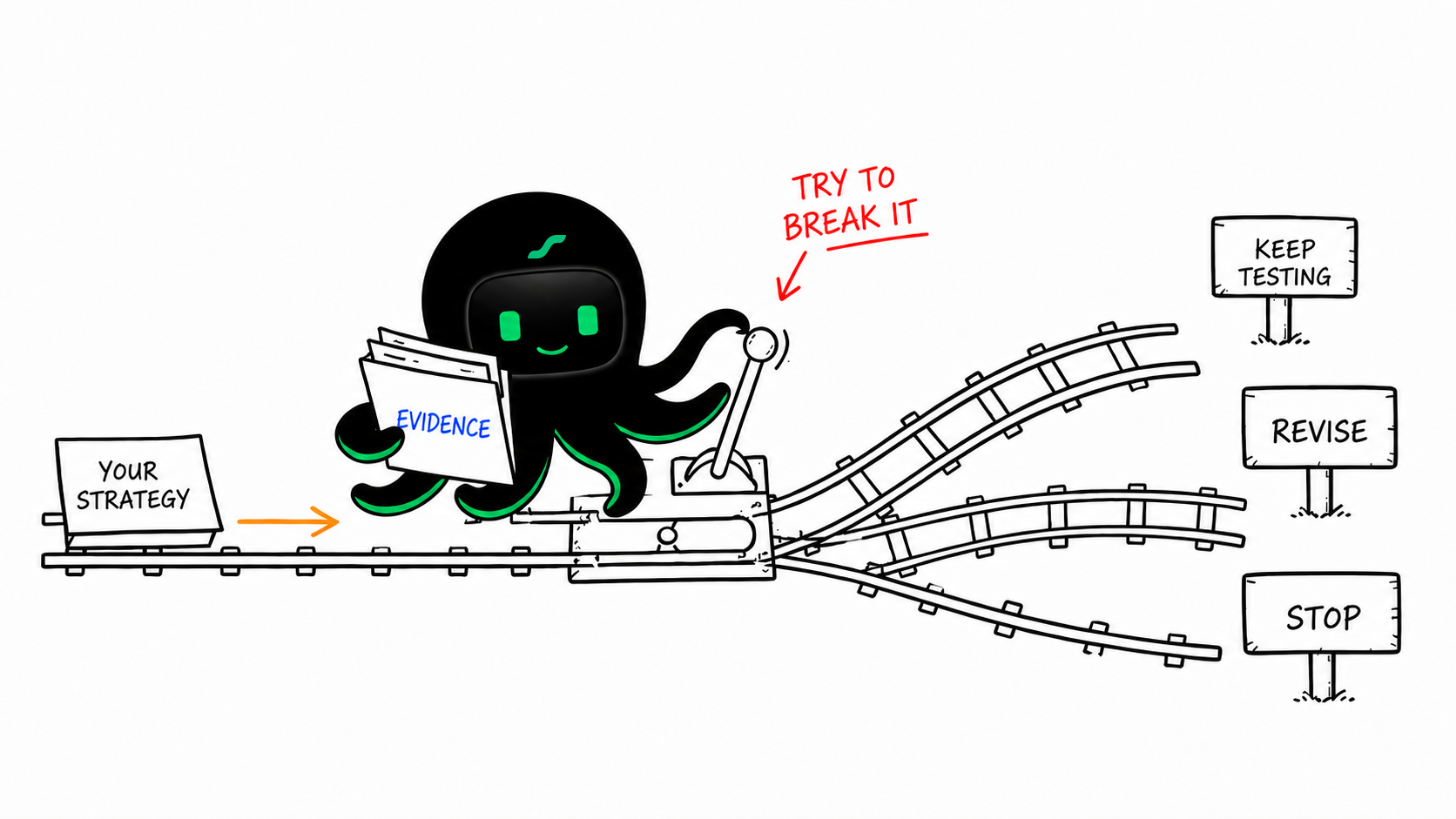
To try the workflow, follow install → ask → verify. Instead of “give me a high-return strategy,” ask: “List this rule’s assumptions, costs, out-of-sample results, and most likely failure conditions. Then give me the next test most capable of disproving it.”
FAQ
Does generating more strategies increase the chance of finding a good one?
It increases the candidate pool, but it also increases false positives. Without stronger out-of-sample, cost, robustness, and multiple-testing controls, scale makes it easier to select a historical champion by accident.
Should AI stop generating strategies?
No. Generation expands the hypothesis space; filtering controls false discovery. The mistake is treating output count as research quality.
Is a conversational product better than a traditional backtester?
Not automatically. It helps only when follow-up questions become reproducible tests tied to the same strategy, assumptions, and evidence. Otherwise it is merely a different interface.
Will EdgePilot decide and place trades for me?
No. EdgePilot Research supports strategy discovery, backtesting, validation, and reproducible reporting. It does not require trading credentials or place live orders. Strategy execution uses the separate EdgePilot Live product, where some capabilities are paid. Trading credentials remain local, and live execution still requires explicit user confirmation.
The decision that matters
The useful AI quant metric is not “how many strategies did we generate today?” It is “how many bad strategies did we reject earlier—and can we explain why?” Generation makes the starting line cheap. Continuous validation on the same evidence keeps the finish from depending on luck.