Profitable Backtest and Paper Trading: Ready to Go Live?
A profitable month is not a graduation certificate. Check what actually happened, whether the settings match, and which important scenarios remain untested.

Two profitable years in a backtest, followed by a profitable month of paper trading: ready to go live? Those durations alone cannot answer that. Time has passed. That does not mean the important problems have shown up. Check what the month actually tested before deciding what comes next.
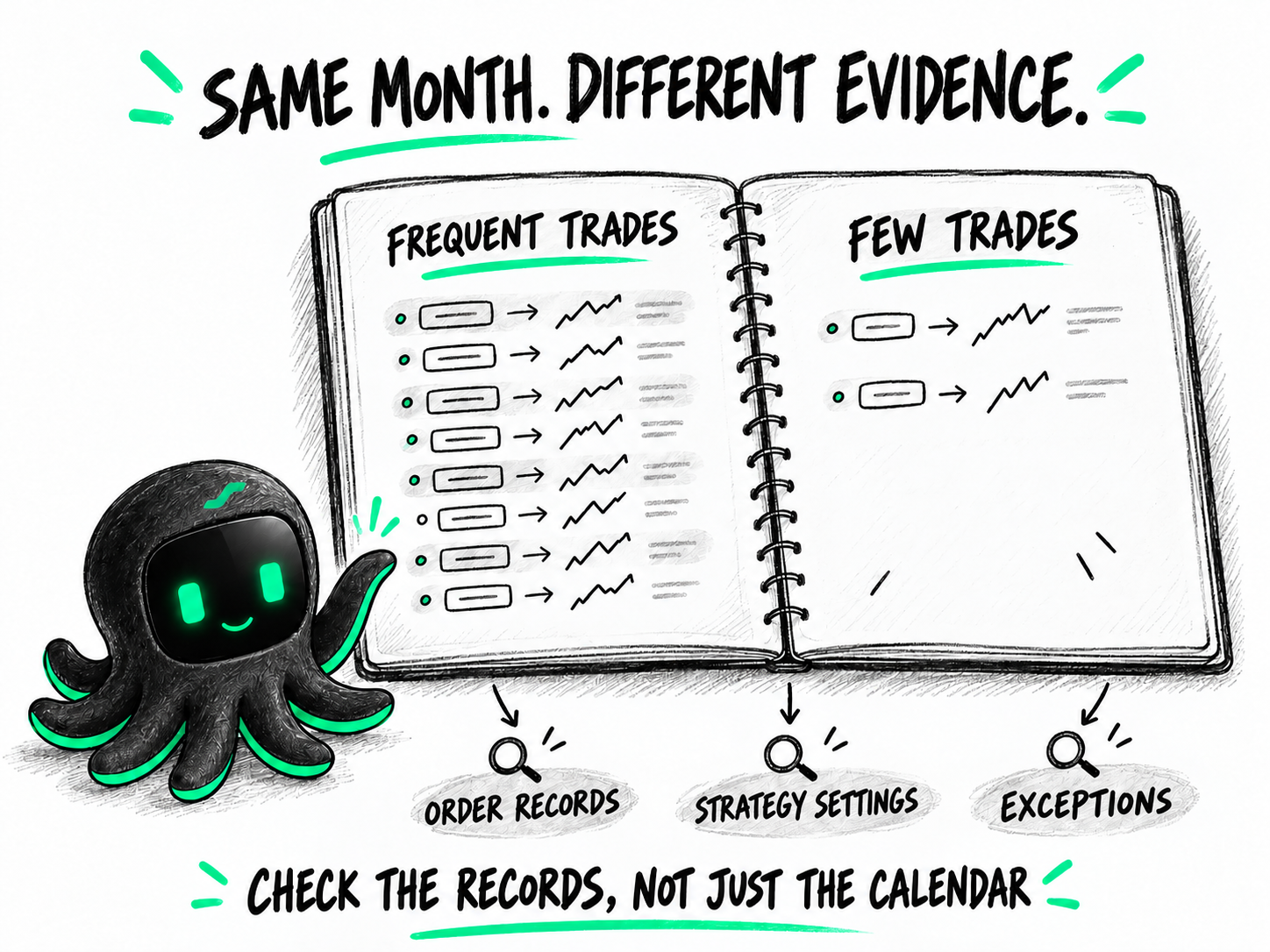
Why can one month of paper trading mean very different things?
Suppose one strategy averages 50 trades a day while another trades twice a month. The first may expose more order and status transitions. The second may not encounter a meaningful market change at all. More trades are not automatically stronger evidence either: many similar trades can repeat the same conditions.
| Trading frequency | What one month may reveal | What to ask next |
|---|---|---|
| Average of 50 trades daily | More order and status transitions | Were conditions varied and failures tested? |
| Two trades monthly | A few individual trade sequences | Did important rules actually trigger? |
A month is not worthless. Its value depends on what happened. A test drive around the block tells you the steering works. It does not quietly certify the car for a long trip in a storm.
What still needs checking when both results are profitable?
Are both runs using the same setup?
Check strategy version, parameters, instruments, and position sizing. An old backtest and a paper run using recently changed rules are not two consecutive tests of the same setup, even if both screenshots are green.
Did you test data that did not help select the parameters?
Repeatedly adjusting settings until one period becomes profitable can confuse memorizing answers with solving new questions. Testing on data excluded from parameter selection helps investigate that problem. Research on backtest overfitting
What happens under less favorable cost and fill assumptions?
First identify the costs already included, then try justified, less favorable assumptions. If a small cost change overwhelms the result, investigate the bill before increasing capital. Paper fills and real fills are also different evidence. Paper versus live execution
Do you know how to stop and investigate a problem?
Review more than normal, profitable operation. What happens after an order rejection, a data interruption, or a partial fill? After stopping, what are the actual order and position states? Write down the situations you need to test and record what happens when they occur or are tested.
The checklist should attach evidence to each “probably fine.” Filling every box does not guarantee safety, and historical performance does not guarantee future results. Understanding hypothetical performance
How do you check the configuration for the next paper test?
Moving between environments often creates a very ordinary problem: which parameter file was tested, where were the fees changed, and which version actually started? Before studying execution, you are investigating your own files.
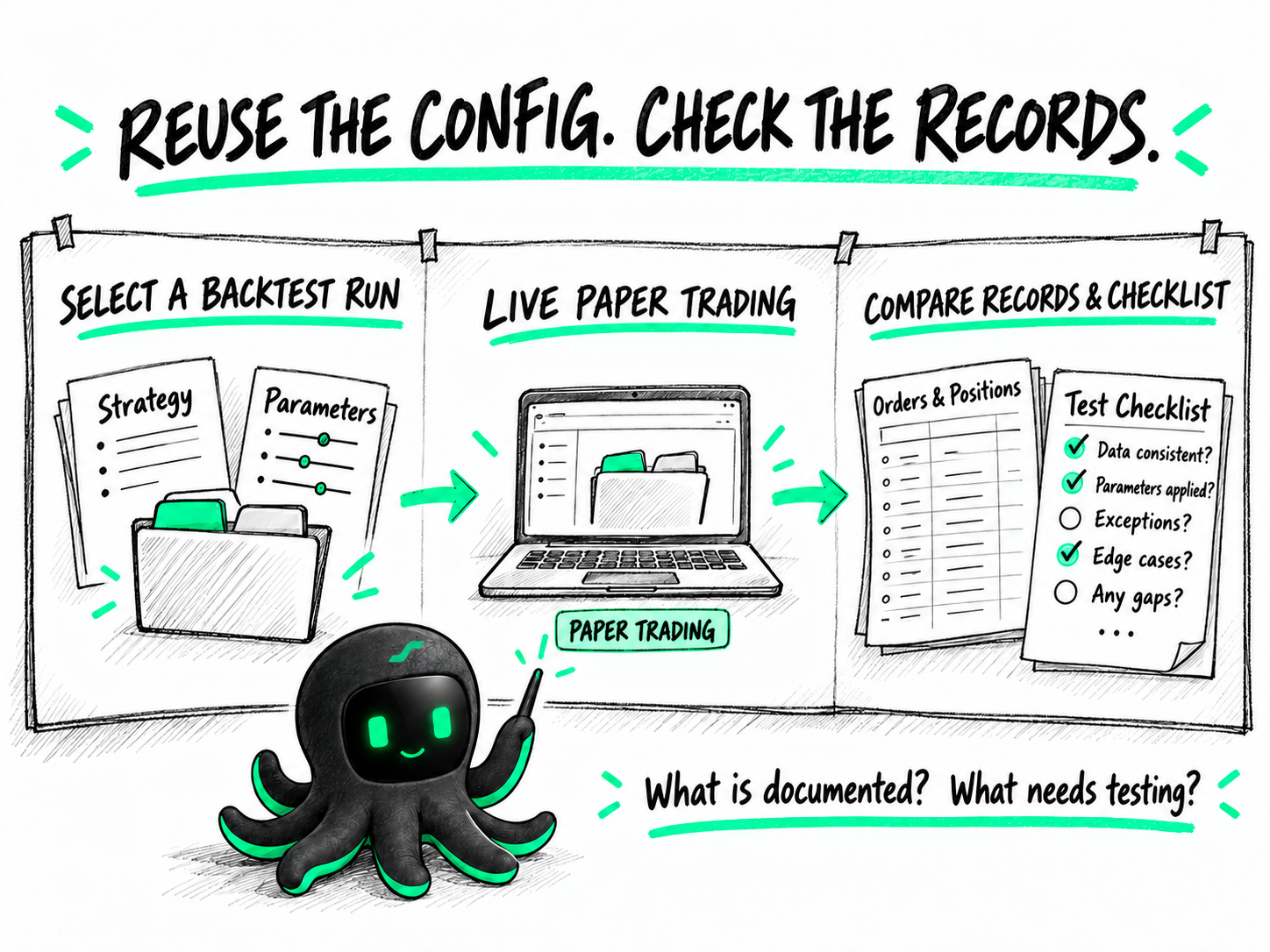
Start by asking EdgePilot Live to read a saved backtest and list its strategy, parameters and market configuration. Compare them with the actual paper run. First identify the environment: the run in these screenshots connects to Binance Demo, an exchange test environment, while the trading node runs locally. This is different from a standalone local matching simulation. Similar settings alone do not establish that a paper run came from a particular backtest.
- Install and enable EdgePilot Live through the official guide.
- Select the saved backtest you want to investigate and check its strategy, parameters and market configuration.
- Confirm the supported test environment and the source of the run. Read the actual orders, fills and positions, then work through your questions. Mark scenarios without records as needing further testing.
| You provide | Use Live to | Then check |
|---|---|---|
| A selected saved backtest | Read its configuration and compare it with the paper run | Whether the strategy and parameters still match |
| Paper-run records | Inspect orders, fills and positions | Whether the actual process follows the rules |
| Questions prepared before testing | Explain the available evidence in conversation | Which scenarios have records and which need more testing |
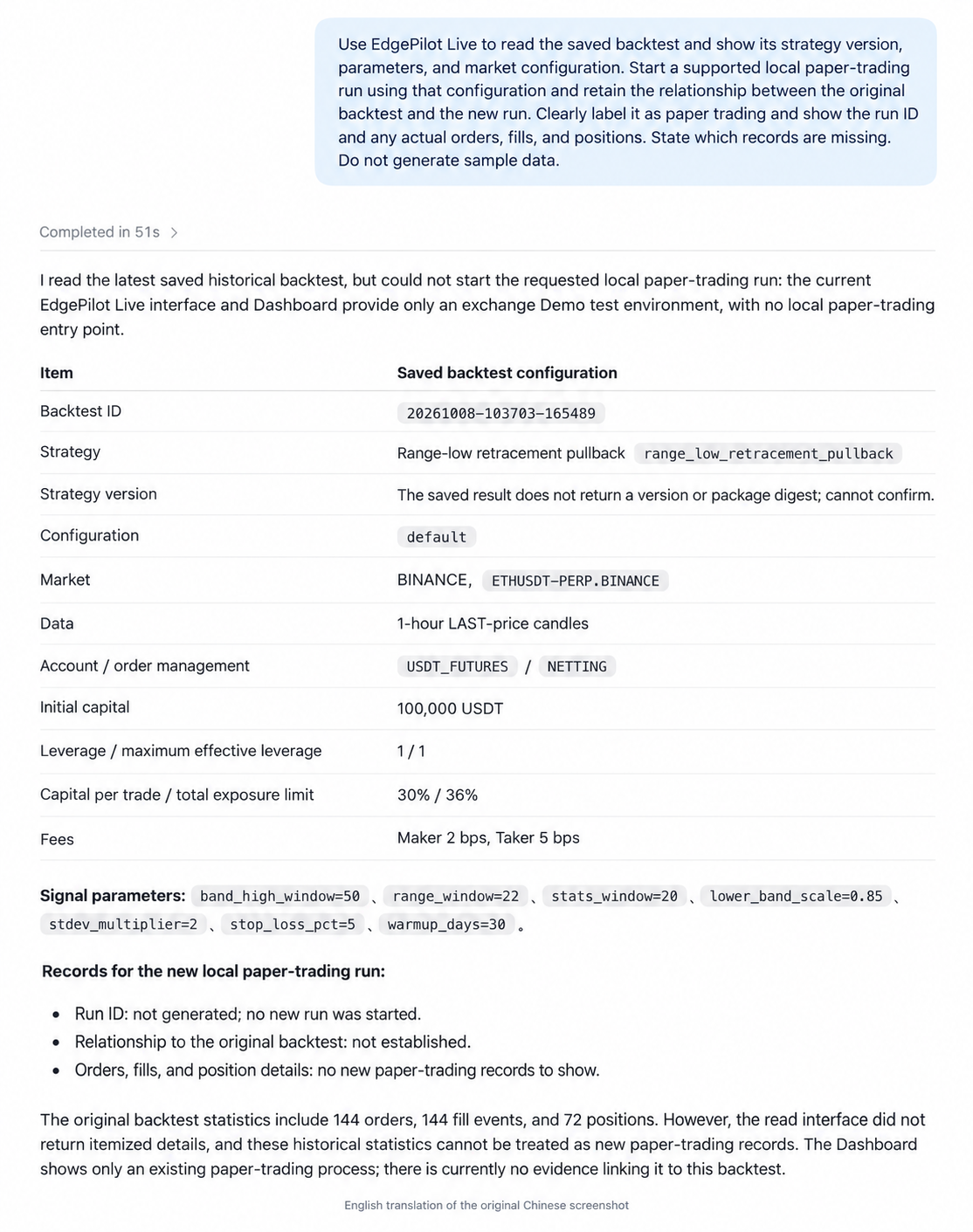
First confirm what can be read and what can be started
The first request asked to read a saved backtest and start a local simulation. The response listed the backtest ID, strategy and parameters, but explained that the current interface did not provide the requested local simulation entry. This request created no new simulation run, orders or positions. Historical order totals from the backtest cannot be presented as records from a new simulation.
Then check the existing paper run and its test coverage
For an existing paper run, provide the backtest run ID, paper-run ID and your test checklist. The screenshot below preserves the original question; the response corrects “local simulation” to Binance Demo exchange paper trading. When using this prompt, name the actual environment and attach the checklist:
Use EdgePilot Live to check this local simulation run: did it use the selected backtest’s strategy and parameters? Based on the existing order, fill and position records, compare it with my test checklist and explain which scenarios have records and what I should test next.
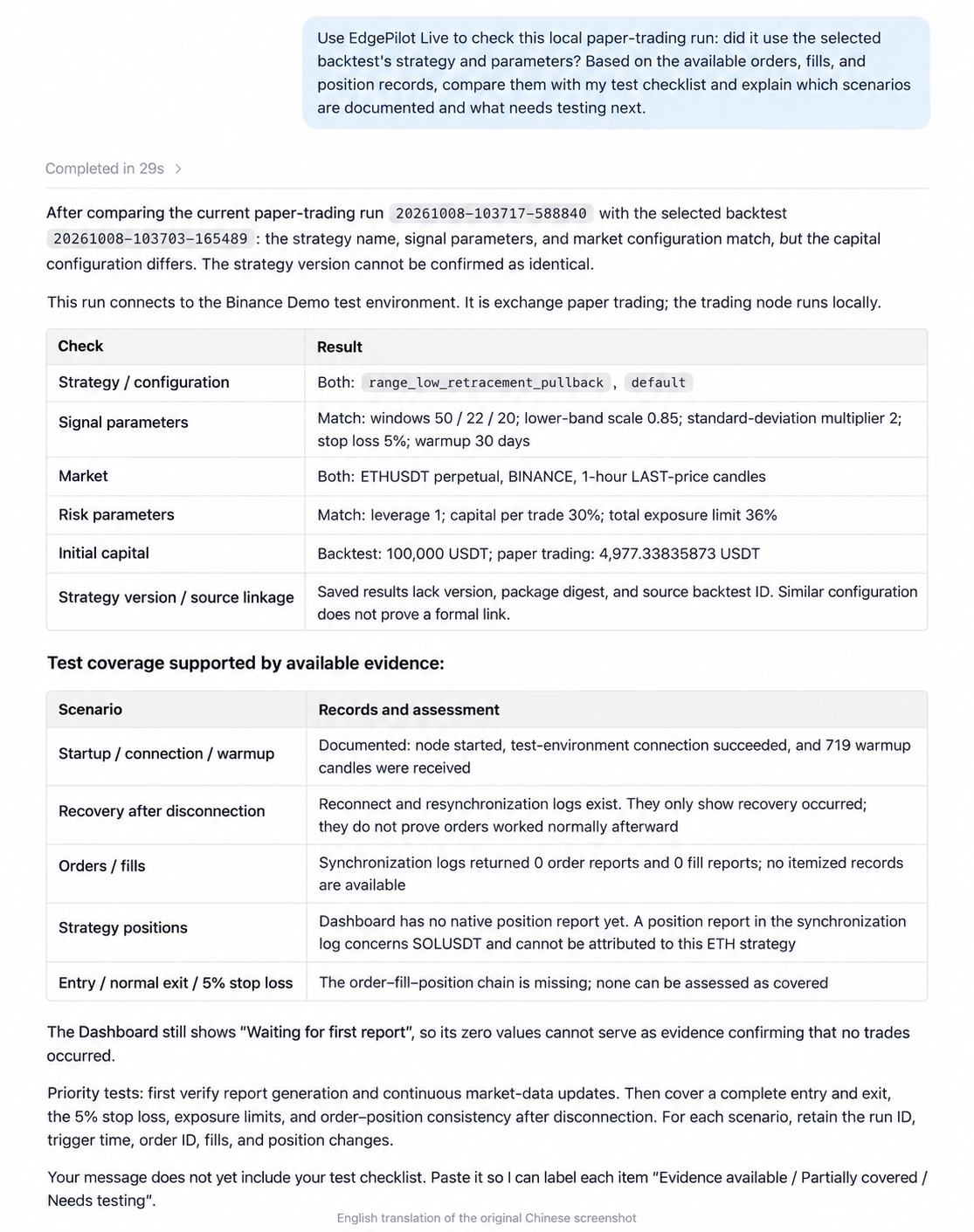
The response confirmed matching strategy names, signal parameters, market and risk settings, but different initial capital. The saved results lacked strategy-version information and the source-backtest ID, so a formal relationship between the runs could not be established. Available material showed node startup, connection and warmup, along with reconnection logs. Without itemized orders and fills, it could not establish that entry, exit and stop-loss behavior had been tested.
The response also noted that the Dashboard was waiting for its first report. Its zero values could not be treated as confirmation that no trading had occurred. The question did not include the checklist, so it still needed to be supplied before marking each scenario as supported by evidence, partially covered or needing another test. Those gaps should guide the next round of testing.
Let the records choose the next test, not the calendar
If the configurations have not been matched, check them first. If an important rule never triggered, test that situation. Any decision to take real-market risk also depends on your capital, market and risk arrangements; two years plus one month cannot make it for you.
You do not need another whole month before reviewing the evidence. Choose one saved backtest and use EdgePilot Live to check the paper configuration and actual records. Answering one specific question beats collecting another green screenshot.
Sources
- Bailey et al.: backtest overfitting
- Interactive Brokers: paper versus live trading
- CFTC: trading systems and hypothetical performance
For trading research and software-testing education, not investment advice. Paper results are not live results and do not guarantee future returns.