Why Does the Same Options Strategy Make Money in Backtests but Fall Short Live?
The directional idea can be right while the execution assumptions are wrong. Match contracts, quotes, fills, and fees to see where the backtest-to-live gap comes from.

An options backtest can make money while actual trades earn much less—even when the directional idea is unchanged. The difference may be in the prices: the backtest books the midpoint, while a real order needs a willing counterparty. Match the contract, quote, fill, and fees before deciding where the profit went.
Why can midpoint prices overstate an options trade’s profit?
The bid is what a buyer offers; the ask is what a seller wants. Their average is the midpoint. It can help value a position, but it is not a guaranteed execution price. Average your offer with a seller’s asking price and the calculator agrees. The seller has not agreed yet.
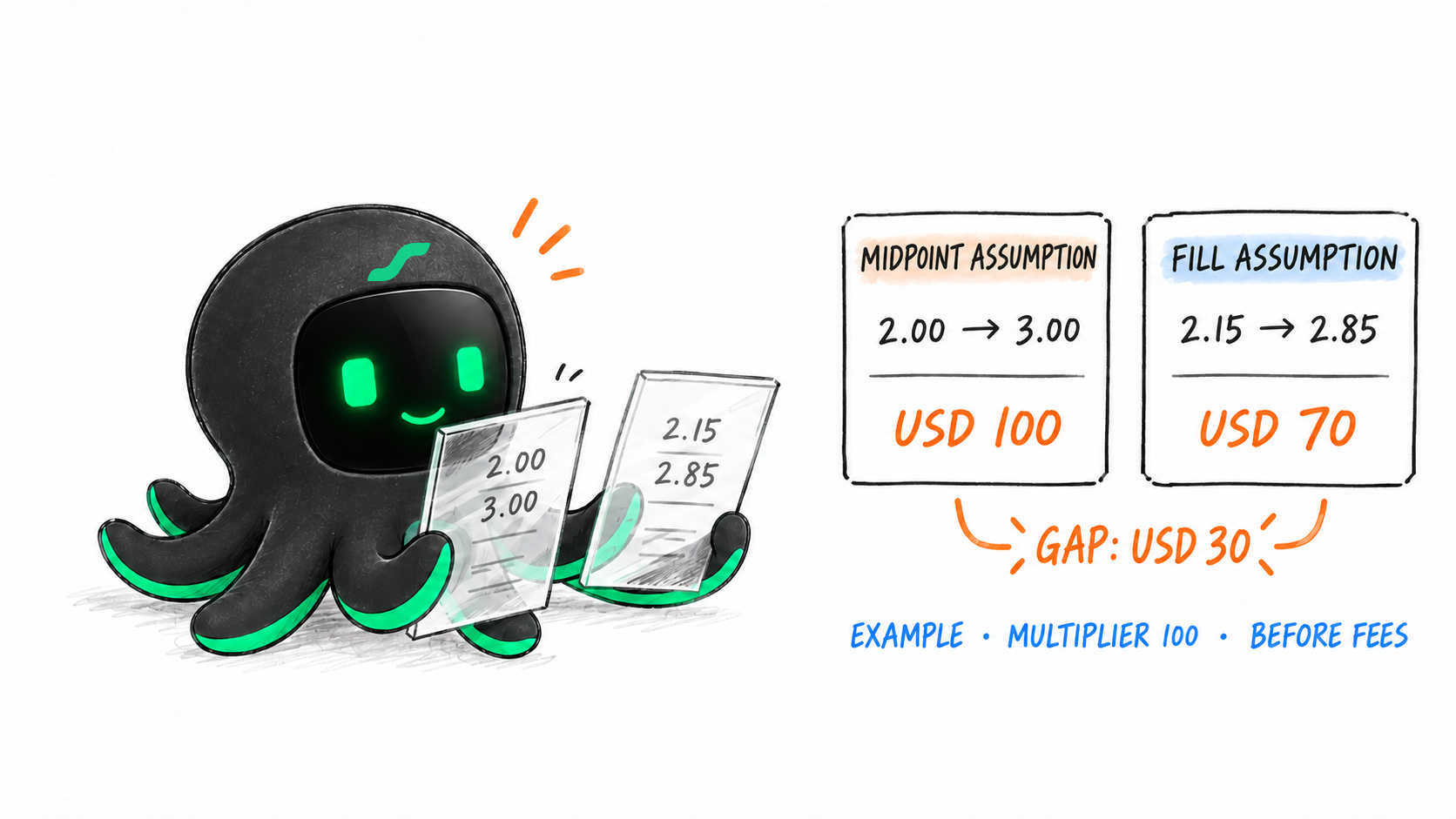
Suppose you buy and later sell one option with a contract multiplier of 100. Keep the contract, quantity, and times fixed; change only the assumed fills. Fees are excluded from both rows.
| Pricing basis | Buy / sell price | Profit for one contract |
|---|---|---|
| Midpoint at each time | 2.00 / 3.00 | (3.00 − 2.00) × 100 = 100 |
| Buy slightly higher, sell slightly lower | 2.15 / 2.85 | (2.85 − 2.15) × 100 = 70 |
| Difference | 0.15 more paid; 0.15 less received | 30 |
Same direction, slightly different prices, $30 less profit. Fees still need to be deducted. Check the actual contract multiplier rather than assuming every option uses 100. The 2.15 and 2.85 fills are this example’s assumptions, not universal slippage settings.
Midpoint fills are not impossible. A limit order may execute inside the spread, but its chance of filling, wait, and size depend on market conditions. The question is whether the backtest assumes that price every time. Bid–ask reference
Are you comparing the same contract and the same trade?
Two bullish positions are not necessarily the same position. Strike, expiration, and multiplier matter. If the contracts differ, detailed arithmetic may simply make the wrong comparison look more convincing.
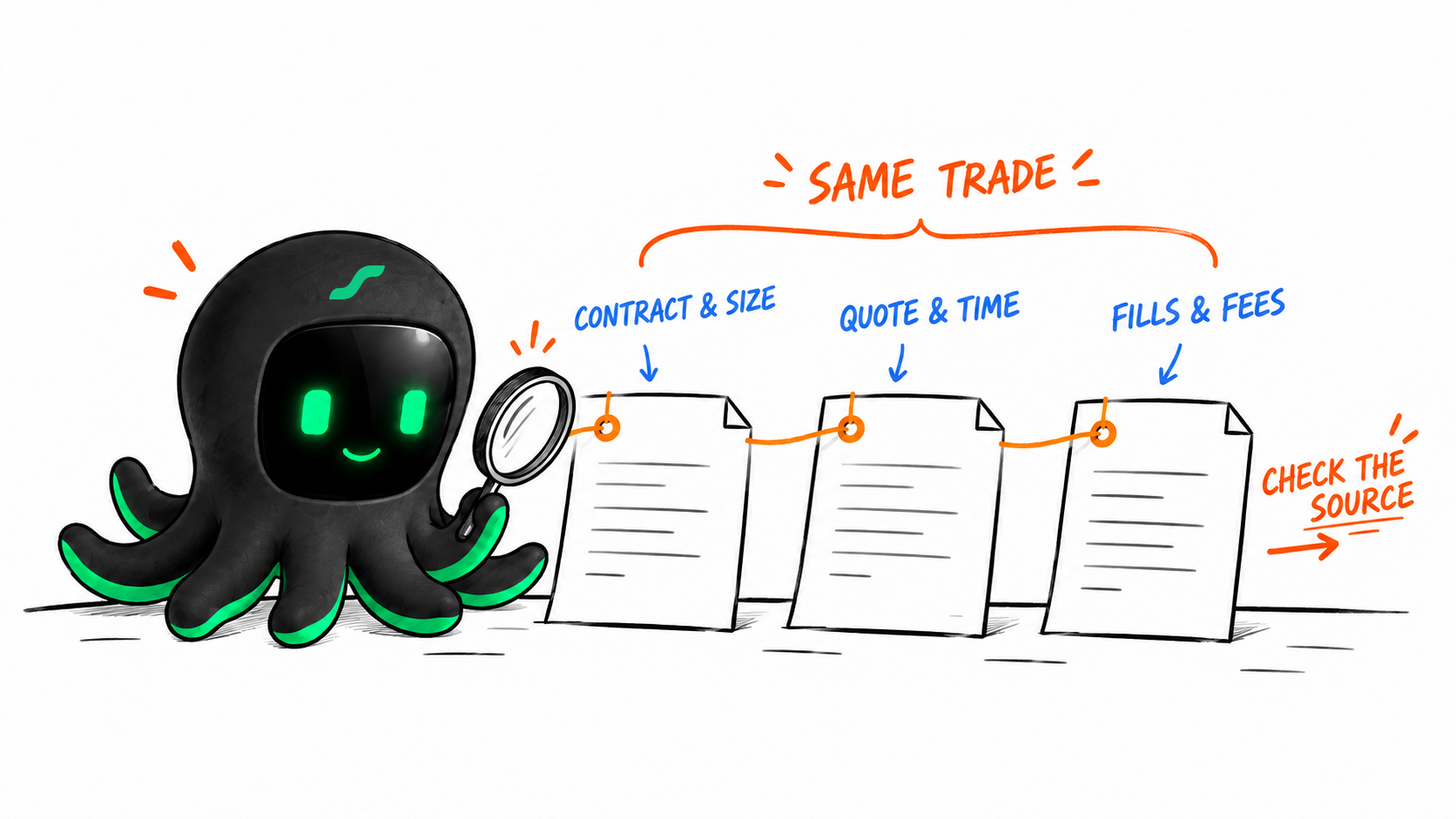
- Match the contract and size. Check underlying, call or put, strike, expiration, multiplier, and side.
- Match the quote to the right moment. Use the bid, ask, and available size at submission, then compare the fill. An end-of-day price is not the quote the order encountered.
- Separate the costs. Keep differences in price assumptions distinct from commissions and other fees. Do not deduct the same cost under two labels.
- Keep the unfilled orders. If the backtest assumes every trade fills, do not evaluate actual execution using only the orders that filled.
What changes when the position has several legs?
A multi-leg position combines several options. Check whether the planned quantities actually filled together, not just the price of each leg. If submitted separately, one leg may fill while another waits, creating a different exposure from the completed position. Complex-order rules depend on the broker and market. Trade-entry reference
If a position reaches exercise or expiration, inspect those events too. Owning a protective leg does not mean every necessary action happens automatically after another leg is assigned. Assignment reference
How do you review quotes, fills, and backtest results together?
The problem is often not a lack of data. It is incompatible views: the report shows a combined position, the broker export lists individual legs, and the screenshot shows only the latest quote. Match the contract and time window before drawing conclusions.
In an EdgePilot Research conversation, AI can explain the strategy material you provide, clarify assumptions, and suggest the next checks. Bring the options backtest’s pricing method together with its corresponding execution material to identify what the two calculations treat differently.
- Install and enable the official EdgePilot Research plugin.
- Collect the contract details, backtest prices, actual fills, and fees for the same trade. Remove account identifiers.
- Ask for a comparison, then check the original material behind the response.
| You provide | Research conversation helps you | Then decide |
|---|---|---|
| Contract details and backtest pricing method | Explain whether the conditions match | Which contract detail or pricing assumption to check |
| Corresponding quotes, fills, and fees | Organize differences and their supporting evidence | Whether to inspect execution prices or duplicate costs first |
| Leg quantities and event records | Identify questions requiring closer inspection | Whether to examine sequencing, unfilled legs, or expiration events |
Attach that material and ask:
Use EdgePilot Research to compare this options strategy’s backtest with the corresponding execution material. Why is actual profit lower than the profitable backtest? First check that contracts, quantities, times, and fees match. Then explain differences in midpoint assumptions, actual fills, and multi-leg records, and identify the first item I should investigate.
What should the review establish in this example?
This is a manual reconciliation of the article’s illustrative inputs, not a real trade record or a plugin response.
- Lock the comparison: the same option, one contract, multiplier 100, matching entry and exit times, before fees.
- Separate the price differences: entry costs 0.15 × 100 = USD 15 more; exit receives 0.15 × 100 = USD 15 less. Total difference: USD 30.
- Collect the missing evidence: obtain bid, ask, and quoted size at the actual fill times, and check that both calculations use the same fee basis. Without those records, do not attribute the gap definitively to the actual bid–ask spread.
- Recalculate: gross profit is USD 70. If total round-trip fees are F, net profit is 70 − F. Take F from the records rather than inventing it.
For a multi-leg position, also retain each leg’s filled quantity, sequencing, and unfilled, assignment, and expiration events. This single-option example does not demonstrate a complete multi-leg execution test.
Follow the answer back to the specific fill or assumption it identifies. The useful outcome is not a score for the strategy. It is a clear explanation of which price or cost assumption accounts for the gap.
Change one supported assumption, then compare again
If idealized fills explain most of the gap, rerun the original backtesting tool with evidence-based execution assumptions. If contracts or times do not match, fix the comparison first. Changing strategy rules and fees together makes it harder to tell what changed the result.
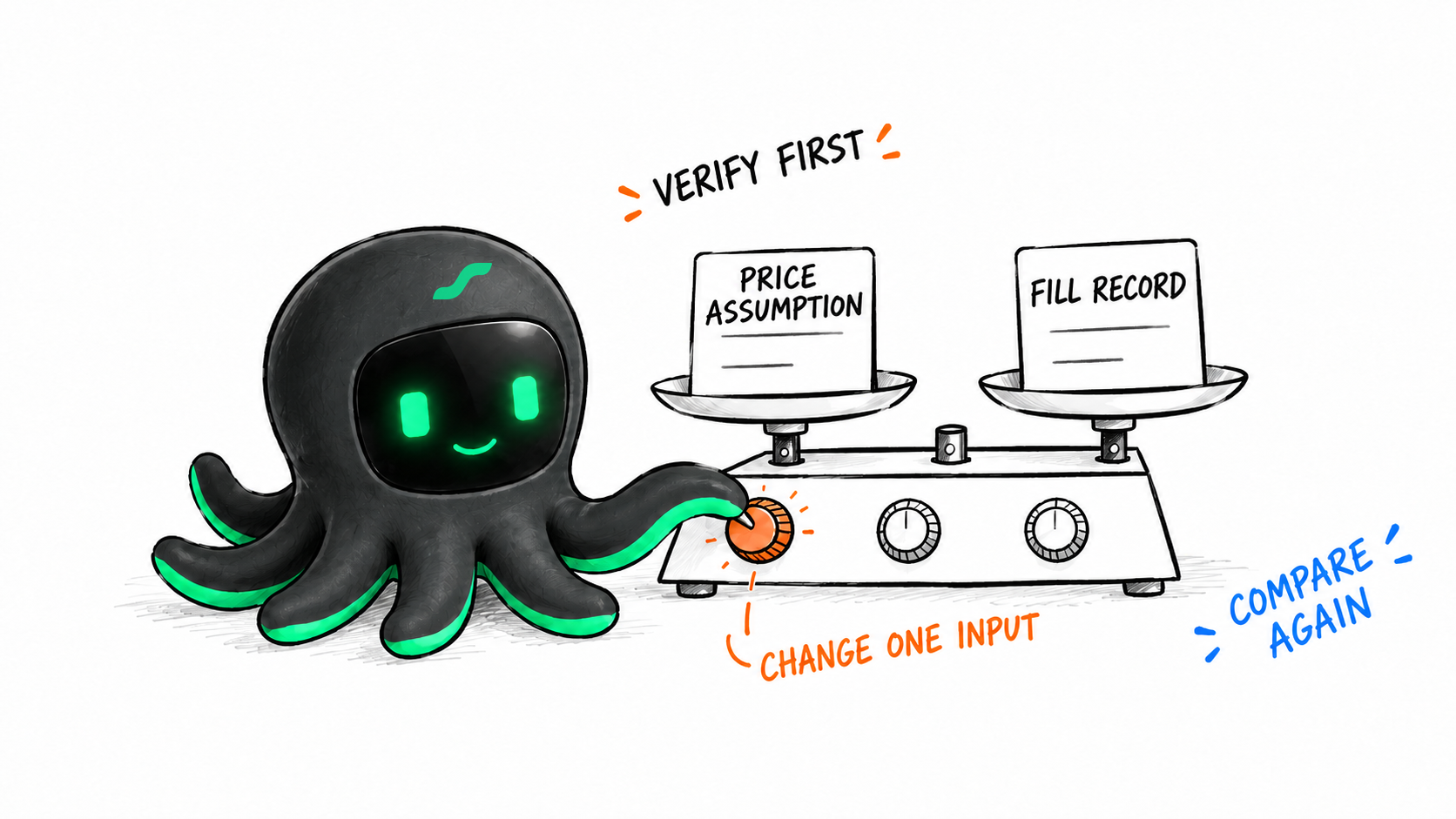
Start with one trade whose records are complete. Use EdgePilot Research to review its backtest prices alongside its execution records. One reconciled trade is a better starting point than another unexplained equity curve.
Sources
- OIC: option bid and ask prices
- Cboe: execution risks of legging multi-part orders
- FINRA: options and their risks
For trading research and education, not investment advice. Options can involve substantial losses. Historical results do not guarantee future performance.