Strategy Works Here but Orders Fail There—Which Exchange Actually Fits?
A working strategy may still fail after moving venues. Check order limits, real costs, test paths, and recovery before choosing by reputation.
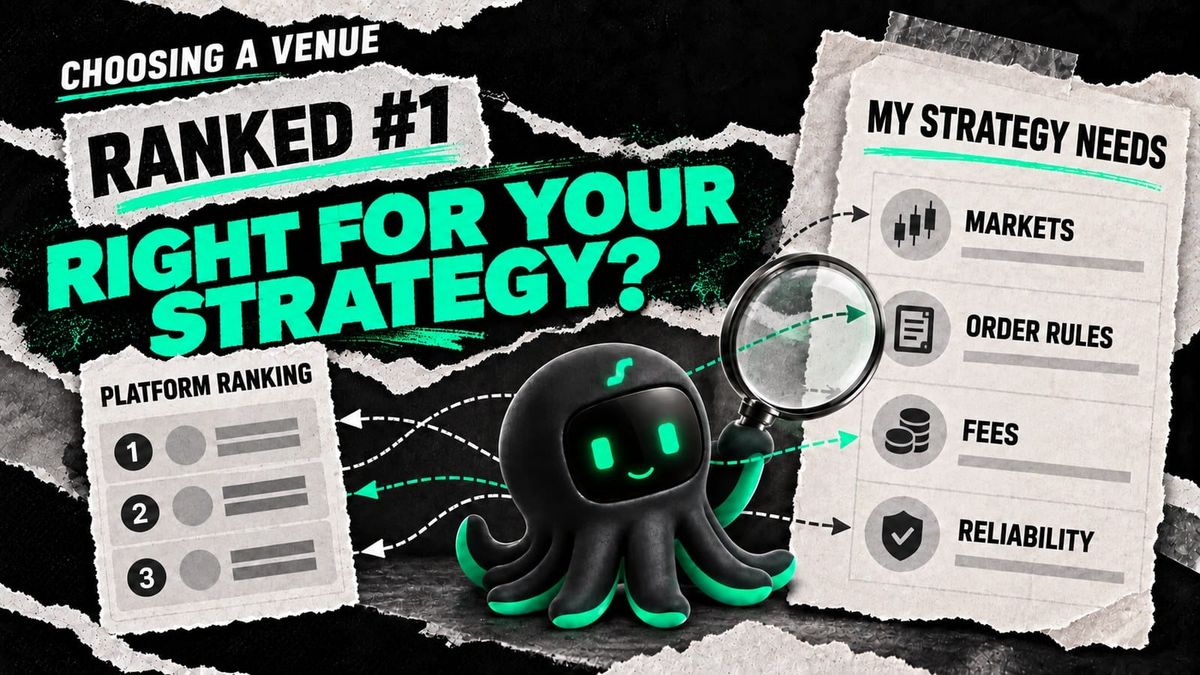
A strategy runs on one exchange, then fails on the first order after you move it. If the order does go through, fees and slippage may eat most of the edge. You think you are choosing the “best” venue among Binance, OKX, Bitget, and MEXC. You are really looking for a rulebook that fits your strategy. This article will not award a trophy. It will help you identify which venue can actually carry the job.
You are not choosing an exchange. You are finding a working environment
Do not start with size. Start with the job: spot or perpetuals? Several orders per minute or one rebalance per week? How thin is the gross profit? Can the capital clear minimum-order rules? When a connection drops, who checks whether the order actually filled?
Those answers shorten the list. Fast systems care about latency, rate limits, and fees. Small grids care about minimum value and precision. Slow systems may care more about instruments, data, and long-term reliability. Ask for a restaurant without saying what you eat, and the ranking will cheerfully recommend the house special. Allergies are apparently a follow-up feature.
Fail one of these five gates and popularity will not save the strategy
- Market fit: The instruments, contracts, and order types the strategy requires.
- Capital fit: Minimum quantity, notional value, and precision that fit the position size.
- Real cost: Fees plus spread, slippage, and funding where relevant.
- Test path: A usable demo environment for the exact product, with known differences from live trading.
- Recovery: A reliable way to handle rate limits, disconnects, partial fills, and uncertain orders.
“This exchange has demo trading” is not enough. The demo may cover only part of the product set. A mall having fitting rooms tells you very little about its parking garage. The real question is whether your account, product, and order can complete the full path.
When do Excel, custom code, or a traditional platform win?
Excel is excellent for a small fixed calculation. A mature engineering team may prefer custom code for unusual execution. A traditional quant platform can also win when its data, language, and workflow already fit.
The real dividing line is not whether a tool is old or new. It is whether the comparison crosses several rulebooks, tests, and review rounds. For one step, Excel, code, or a traditional platform may work perfectly. When every venue change means checking rules again, copying settings, and tracking another version, the gaps between tools start consuming the time. Many teams reach for AI at that point—but if it answers one question and disappears, the workflow is still broken.
Do you really have to start over for every exchange?
This is where a normal chat with AI often breaks apart. You ask about venue rules, copy settings into a sheet, and run the test somewhere else. The first thing lost is usually not the result. It is the answer to “Which version and rules produced this result?”
You do not need to know the phrase agent-native first. In plain English, it means the AI stays with the task instead of answering one question and disappearing. It can clarify strategy and capital requirements, inspect public evidence, preserve versions and test settings, and connect the next validation step. The context stays attached to the work.
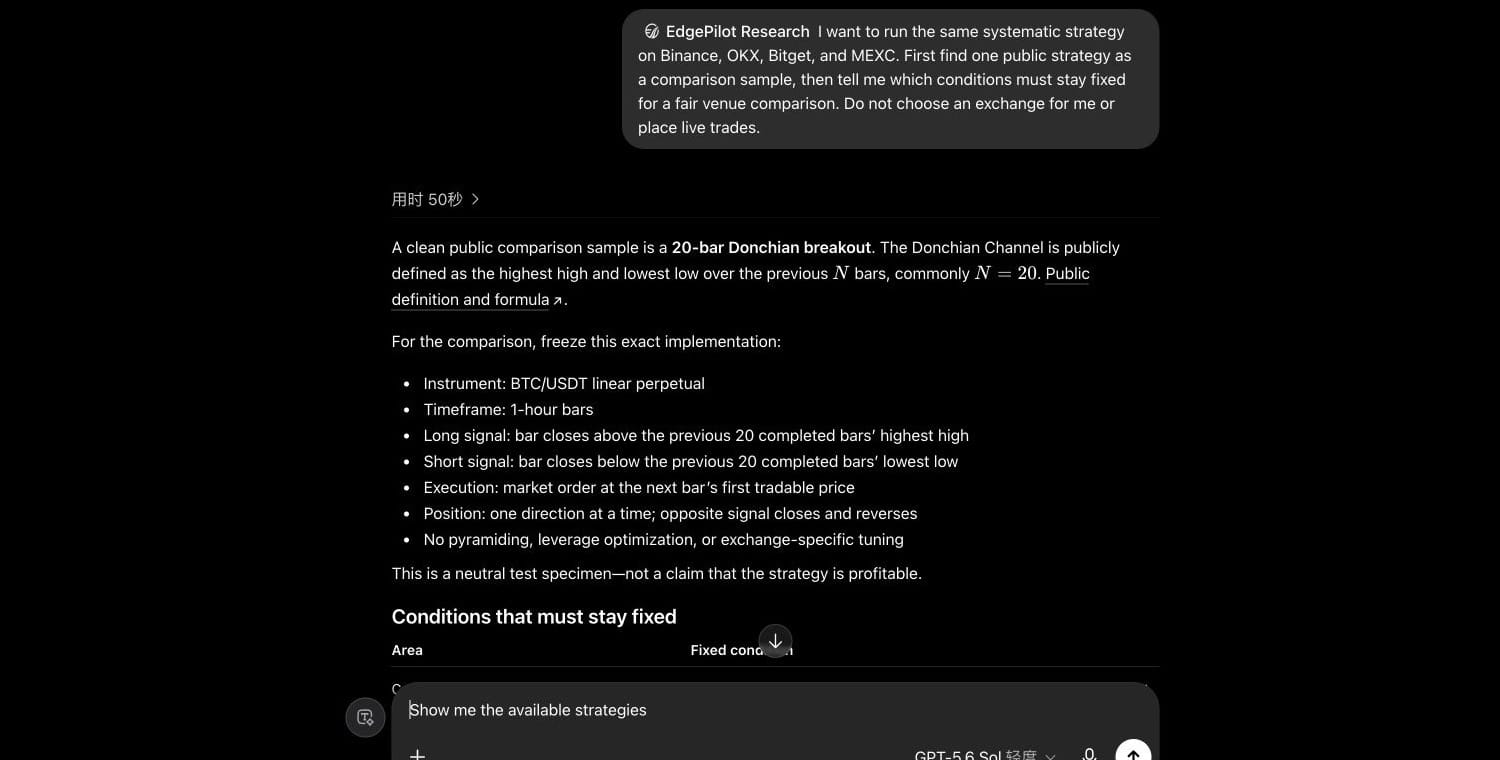
That is how EdgePilot Research is designed to help. It can use the plugin to discover public strategies, inspect versioned evidence, and run historical tests for supported packages. In an exchange comparison, its job is not to declare Binance, OKX, Bitget, or MEXC the winner. It helps freeze the strategy and comparison assumptions and preserve what each test used, so you can compare which rule may have changed the outcome.
Do not vote. Run the same small test twice
Narrow the list to two venues. Freeze one strategy version, one risk budget, and one test period. Then check whether orders are valid, total cost is tolerable, and failures can be recovered. Reputation can put a venue on the shortlist. It cannot sign the test result.
Rankings tell you who is popular. An agent-native workflow helps you find who fits this job. You still own the risk budget and the live-trading decision. Choosing an exchange is not electing a class president.

Next step: Write the strategy requirements, then shortlist two
Use EdgePilot Research to organize this validation. Start with the one condition most likely to reject the order or change net profit instead of comparing twenty dimensions at once.
Have a grid strategy in mind? See what changes when the same grid moves between venues. Already testing the move to a live account? Check what demo success does—and does not—tell you.
Sources
This article is for trading research and software-testing education, not investment advice. Exchange rules, regional availability, and interface capabilities can change; verify current official documentation before execution.